[Post title]
[One or two sentences summarising the post.]
Read more

ACRL combines field observations, environmental monitoring, laboratory analysis and computational modeling to improve understanding of air pollution and regional atmospheric conditions in Bangladesh.
About the labBuilding the emission inventory, air quality models, monitoring data and local expertise Bangladesh needs to plan and track its national clean air program.
Learn moreA vehicle-mounted unit that maps air pollution at finer spatial resolution than fixed stations can provide.
Learn moreJoin us
Open positions, fellowships and student opportunities are announced here and on LinkedIn. Open now: PhD Research Fellowship in mobile air quality monitoring, until 31 October 2026.








Room 652, Dr. Jamilur Reza Choudhury Civil Engineering Building
Bangladesh University of Engineering and Technology
Dhaka-1000, Bangladesh
Facilitating a clearer picture of air pollution and climate management in Bangladesh.
Who we are
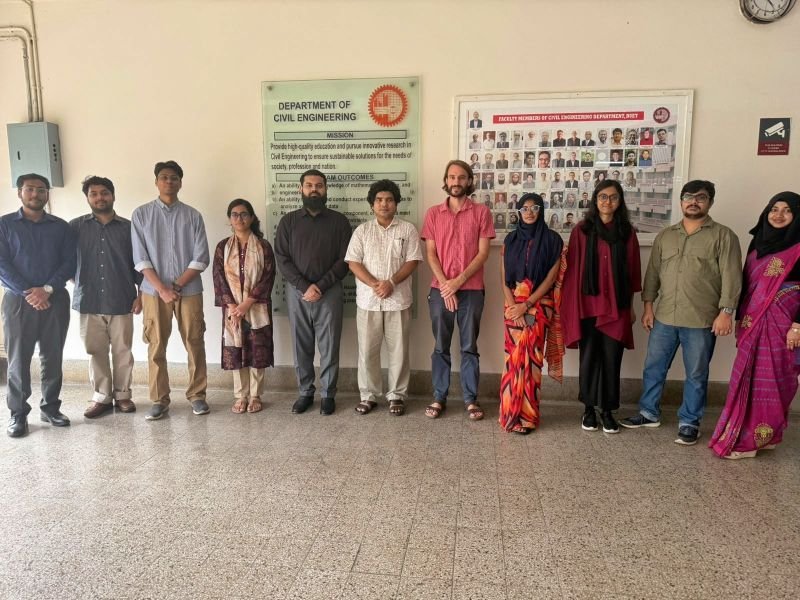
The Air and Climate Research Lab (ACRL) at Bangladesh University of Engineering and Technology works on atmospheric science, air quality and climate.
It combines field observations, environmental monitoring, laboratory analysis and computational modeling to improve understanding of air pollution and regional atmospheric conditions. [Add: when the lab was founded, and its mission in one line]
Four connected steps, from collecting data to explaining it.
Measurements across urban, rural and near-source sites in Bangladesh.
Reference-grade, chemically speciated and low-cost sensor networks.
Chemical analysis of PM₂.₅ to identify pollution sources.
Emission inventories, chemical transport and data-driven models.
Developing Tools to Improve Air Quality Management in Bangladesh
Mobile Air Quality Monitoring Unit for High-Resolution Air Pollution Mapping
Room 652, Dr. Jamilur Reza Choudhury Civil Engineering Building
Bangladesh University of Engineering and Technology
Dhaka-1000, Bangladesh
Get in touch with the lab or reach a member directly.
Room 652, Dr. Jamilur Reza Choudhury Civil Engineering Building
Bangladesh University of Engineering and Technology
Dhaka-1000, Bangladesh
| Name | Designation |
|---|
Methods applied across projects to measure, model and explain air pollution in Bangladesh.
Five connected areas of work, shared across the lab’s projects.
High-resolution estimates of emissions from major and minor sources, mapped across the country.
Chemical transport and reduced-complexity models to test policies before they are put in place.
Using the chemistry of PM₂.₅ to find out where pollution comes from.
Monitoring across urban, rural and near-source sites, with mapping of population exposure.
Training regulators, students and professionals, and opening data to the public.
Projects that build the data, models and expertise Bangladesh needs to manage air pollution.
Building the emission inventory, air quality models, monitoring data and local expertise Bangladesh needs to plan and track its national clean air program.
Bangladesh University of Engineering and Technology · University of Washington · University of Dhaka · Department of Environment, Bangladesh · University at Albany · Clarkson University · IIT Bombay · Istanbul Technical University
University of Washington
Provat Kumar Saha · Julian Marshall (Co-PI) · Sheikh Mokhlesur Rahman
Project pagePart of this project
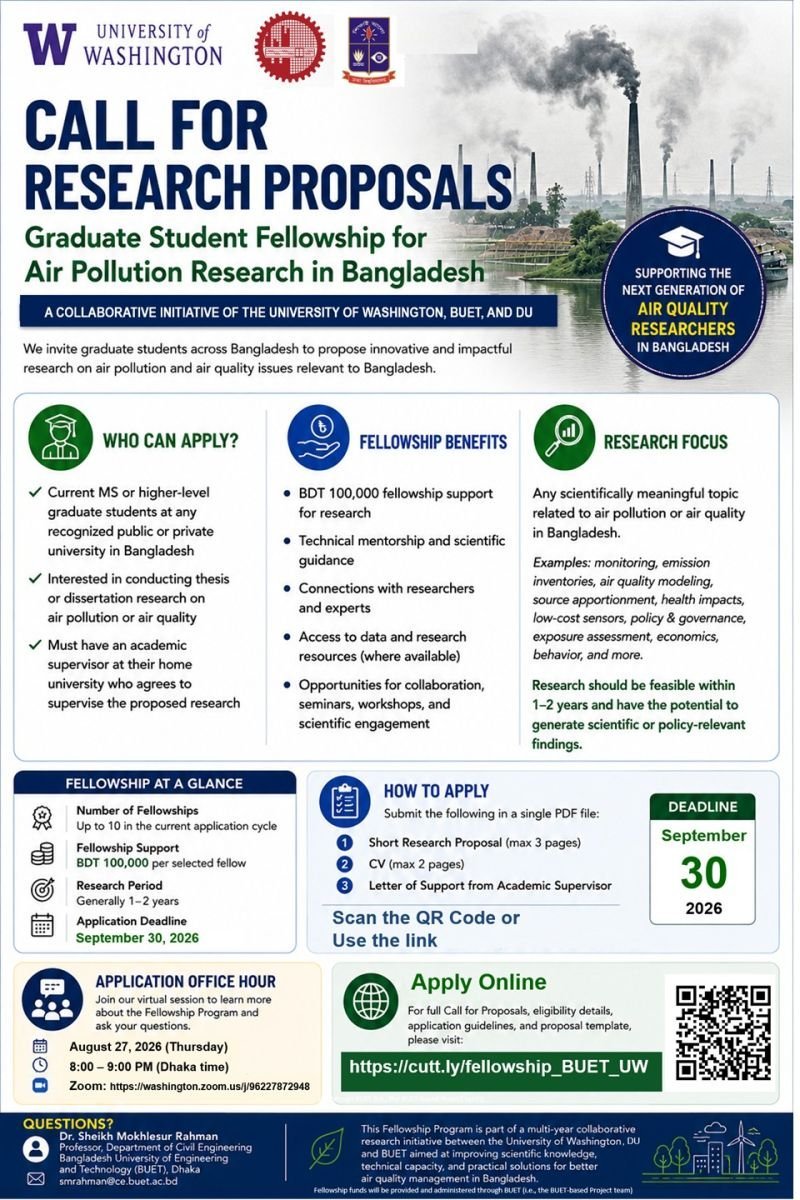
About 30 graduate students over three years, up to 10 per annual cycle, each receiving BDT 100,000, mentorship and access to data.
A vehicle-mounted monitoring unit that maps air pollution at finer spatial resolution than fixed stations can provide.
Department of Civil Engineering, Bangladesh University of Engineering and Technology
Higher Education Acceleration and Transformation (HEAT) Project, University Grants Commission of Bangladesh
Sheikh Mokhlesur Rahman
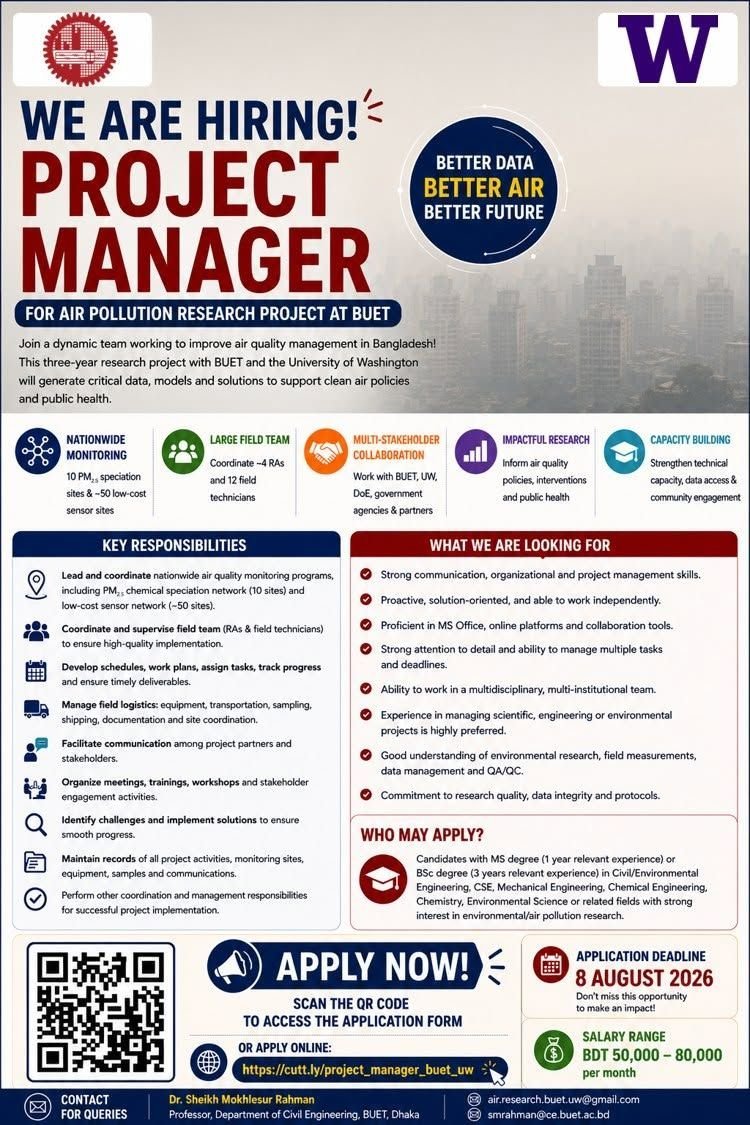
Project pageTo give Bangladesh the data, models, and trained people needed to design and track air quality mitigation.
High-resolution estimates of emissions from major and minor sources, mapped across Bangladesh.
A model that links sources to pollution levels, to test interventions before they are put in place.
Using the chemistry of PM₂.₅ from 10 speciation sites to find out where pollution comes from.
About 50 low-cost sensor sites feeding data-driven air quality models.
Training for Department of Environment staff and local professionals, public data and community outreach.
Chemical speciation sites and low-cost sensors placed across urban, rural and near-source locations in Bangladesh.
Part of this project
Supports graduate students across Bangladesh to carry out thesis or dissertation research on air pollution. Over the three-year project, about 30 students are supported, up to 10 per annual cycle, selected competitively.
Eligible: current MS or higher-level graduate students at any recognized public or private university in Bangladesh, with a supervisor at their home university.
A vehicle-mounted monitoring unit that maps air pollution at finer spatial resolution than fixed stations can provide.
Building the vehicle-mounted unit and calibrating its instruments so its readings can be trusted.
Turning on-road measurements into fine-grained pollution maps and using them to check model results.
Combining mobile measurements with spatial data to estimate air quality between measured streets.
Field campaigns that collect the measurements behind the project's empirical models.
Routes driven by the mobile monitoring unit to build high-resolution pollution maps.
Open position
One full-time PhD Research Fellow will join the project to work on mobile air quality monitoring.
Eligible: enrolled full-time PhD students in BUET Civil and Environmental Engineering.
A community for people working on air quality in Bangladesh: sessions, writing and shared resources.
[What the network is, who runs it, and who it is for: two or three sentences.]
Researchers, students and practitioners working on air quality in Bangladesh are welcome to join. Members hear about new sessions, posts and resources.
Peer-reviewed papers, reports and datasets from ACRL members and projects.